
Using the Technology Acceptance Model to Investigate the Effect of Self-Efficacy on Gesture Control in Virtual Reality
##plugins.themes.bootstrap3.article.sidebar##
##plugins.themes.bootstrap3.article.main##
Abstract
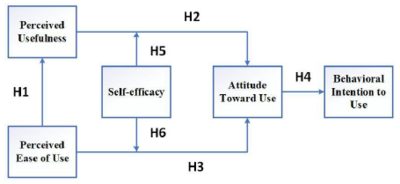
The growth in distance learning during the COVID-19 pandemic has made the incorporation of touchless control into virtual reality (VR) worth investigating. This study used a head-mounted VR device for a virtual art gallery software program (GOXR) and adopted the technology acceptance model (TAM) to analyze how well senior high school students in New Taipei City accept gesture control in VR, thereby investigating the effect of self-efficacy on technology acceptance. This study used the TAM as the foundation to perform a questionnaire survey among the aforementioned students. This study distributed 272 questionnaires and collected 271 valid responses; thus, the response rate was 99%. The conclusions of this study are as follows. First, students’ acceptance of gesture control in VR did not differ significantly in relation to sex or experience of using VR headsets. Second, perceived usefulness, perceived ease of use, attitude toward use, and intention to use had significant positive correlations with each other. Third, self-efficacy did not have a significant moderating effect on the relationship between perceived usefulness and attitude toward use or the relationship between perceived ease of use and attitude toward use.
##plugins.themes.bootstrap3.article.details##

This work is licensed under a Creative Commons Attribution-NonCommercial-NoDerivatives 4.0 International License.